


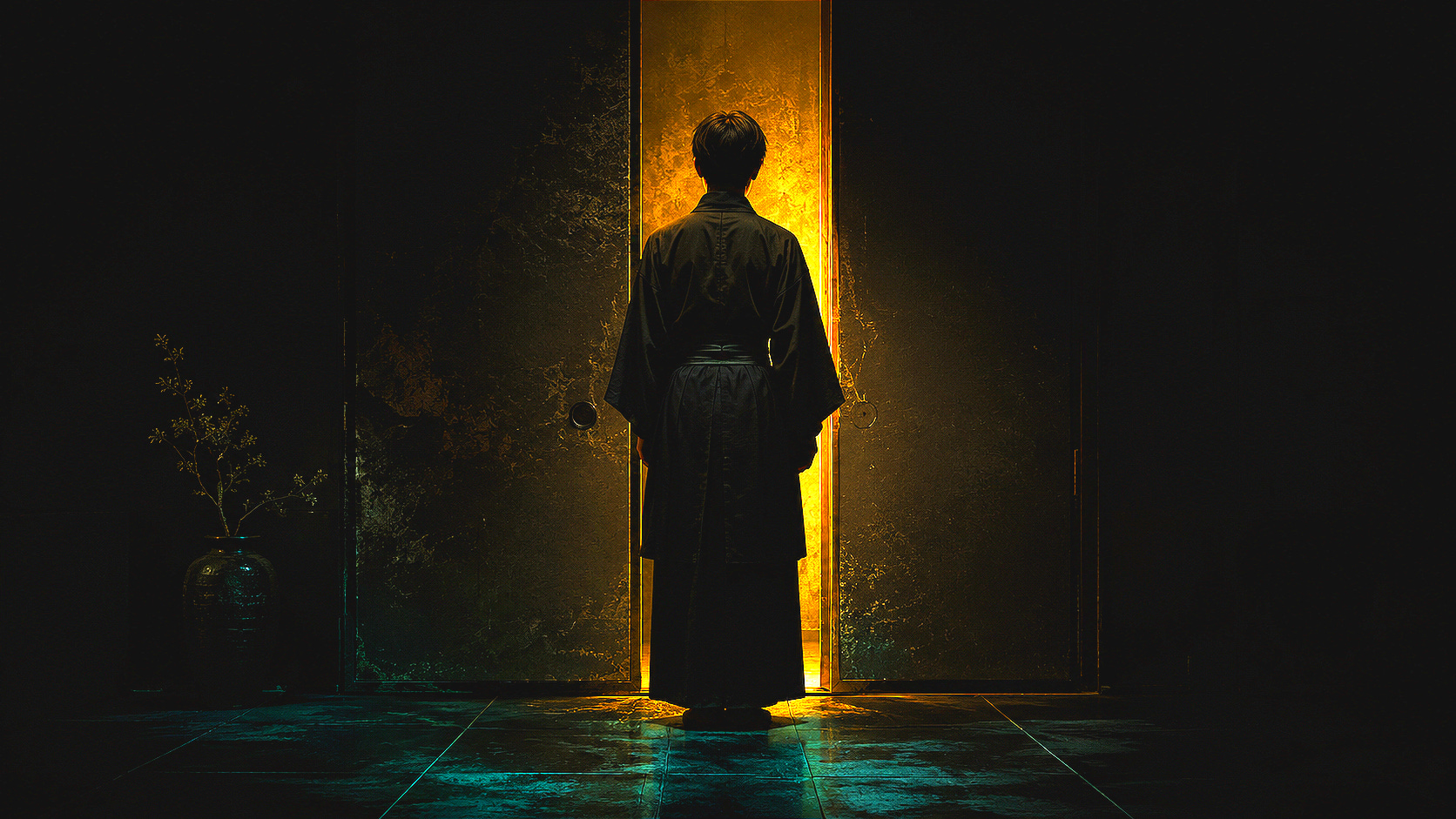
There is a concept from the deep mythology of Twin Peaks that I keep returning to.
David Lynch and Mark Frost called it the Dweller on the Threshold.
The idea is ancient — older than Lynch, older than television, older than most of the frameworks we use to make sense of difficult moments. It comes from esoteric tradition. But Lynch gave it a face. A presence. Something you could feel rather than just understand.
At every significant crossing point in a life — every moment where something genuinely new is possible — there is a figure waiting at the threshold.
Not a gatekeeper who decides whether you may pass.
Not an enemy to defeat.
A presence that embodies everything unresolved in you.
The fears you haven’t named. The desires you stopped allowing yourself to feel. The version of your life you buried — not because it wasn’t real, but because someone you loved told you it wasn’t possible. Or appropriate. Or yours to want.
The Dweller is not external.
It is everything you agreed to suppress in order to remain acceptable to the people and systems you were born into.
And here is the part that matters most.
You cannot cross the threshold without facing it.
Most people don’t. Most people feel the Dweller’s presence — that particular quality of dread that arrives when you get close to the thing you most want — and they turn back. They return to the familiar. To the managed version of themselves. To the life that looks fine from the outside.
And they call it sensible.
I stood at my threshold for thirteen years.
The business was growing. Revenue was climbing. By every external measure, things were working.
But I could not leave.
Not because leaving was impossible.
Because he was my father.
The Dweller at my threshold wore his face. Spoke in his voice. Carried every conversation we’d ever had about loyalty and responsibility and what it meant to be a son.
Every time I approached the threshold — every time I felt the pull toward my own authority, my own version of the work, my own life — the Dweller was there.
And I turned back.
For thirteen years.
What I didn’t understand then — what took the full weight of those years to learn — is that the Dweller is not the enemy.
The Dweller is information.
It tells you precisely what is unresolved. What you have not yet given yourself permission to want. What you are still carrying that belongs to someone else.
The Dweller is the inventory of everything you agreed to suppress in order to be loved.
And the crossing — when it finally comes — is not a triumphant moment.
It is quiet. Painful. Necessary.
You look at what is waiting there and you say: I see you. I know where you came from. I know whose voice you’re using.
And I am walking through anyway.
This is the work I do now.
Not because I studied it.
Because I survived my way to the other side of it — and discovered something waiting there that I hadn’t expected.
Clarity.
Not the absence of difficulty. Not the end of complexity. Not a life without weight.
But the particular clarity that comes when you are finally operating from your own ground rather than someone else’s.
When the decisions you make are yours.
When the voice that guides you is no longer borrowed.
When the signal you transmit — in your writing, in your coaching, in the quality of your presence in a room — is no longer managed or performed or diminished before it reaches the people who need it.
I meet people at the threshold.
That precise moment when they know — somewhere beneath the noise of daily life and professional responsibility and the voices of the people who love them — that something needs to change.
They can feel it. They’ve been feeling it for months. Sometimes years.
But the Dweller is there.
And it is convincing.
It speaks in the language of responsibility. Of loyalty. Of what it would mean — about who you are — if you chose yourself.
It speaks in the voices of the people whose approval you cannot stop needing.
It shows you everything you might lose.
And it says: is it really worth it?
Here is what I know from standing at my own threshold for thirteen years.
The cost of staying is not a business cost.
It is a life cost.
It is the accumulation of postponed decisions and suppressed desires and the daily low-level diminishment of showing up as a managed version of yourself — giving a fraction of what is actually available — waiting for a moment of permission that the other person may never be able to give you.
The Dweller does not shrink while you wait. It grows.
Every year you stay on the wrong side of the threshold — every year you choose the familiar over the true — the Dweller gets stronger. More detailed. More convincing.
Because you have given it more evidence.
More proof that you cannot cross.
More data for the case it makes against you every time you approach.
The only thing that diminishes the Dweller is movement.
Not preparation.
Not more thinking.
Not another framework, another programme, another year of getting ready.
Movement.
One step across the threshold — taken before you feel ready, before the Dweller has been fully defeated, before you are certain of what is waiting on the other side — changes everything.
Because the moment you cross, you discover something the Dweller never told you.
The other side exists. And it was always there.
Waiting not with judgement but with the particular relief of a life that fits — of operating from your own authority rather than borrowed permission.
This is what I build my work around.
The Resonant Edge — the internal state that makes the crossing possible. The particular quality of calm, sharpened readiness that allows you to face the Dweller without being destroyed by it. Without performing strength you don’t feel. Without pretending the threshold isn’t terrifying.
Just present. Grounded. Ready.
And the Signal — what naturally emerges when you are finally operating from full depth rather than managed surface. The writing that hums. The coaching that lands. The presence in a room that changes the room before a word is spoken.
Signal is what happens after the crossing.
It cannot be manufactured before it.
You cannot perform your way across a threshold.
You cannot strategise your way past the Dweller.
You cannot content-plan your way to a life that is genuinely yours.
At some point — and every person who has ever done meaningful work knows this moment — you have to face what is waiting there.
And walk through.
If you are reading this and something in you has gone quiet —
that particular quality of recognition that arrives when something names a thing you have been carrying without words —
then you are probably closer to your threshold than you think.
The Dweller is not a sign that you are wrong.
It is a sign that something true is waiting on the other side.
The question is not whether you are ready.
The question is whether you are willing.
If this named something you’ve been carrying — I’d like to hear what it brought up for you. Reply here, or send me a message and we can carry on the conversation